What is it that breathes fire into the equations and makes a universe
for them to describe?
The cosmos is within us.
We are made of star stuff.
Astro-Not Explorer Challenge · 15 free projects
Deep Learning in Astronomy · Participation certificates
The universe is not out of reach. You can achieve it too.
ASTRO-NOT guides curious students from their first telescope night to real research — through live webinars, hands-on projects, and mentorship that treats young minds like future scientists.
What our students are saying
Based on 36 student reviews
Six windows. Pick one and it opens.
Each panel is a door. Click it and it splits open onto that part of ASTRO-NOT.
Start your journey into space
Reach out about webinars, courses, mentorship, school collaborations, and research-oriented learning programs.
Scientific Coding Course
A structured monthly program that takes you from the fundamentals to scientific computing and AI.
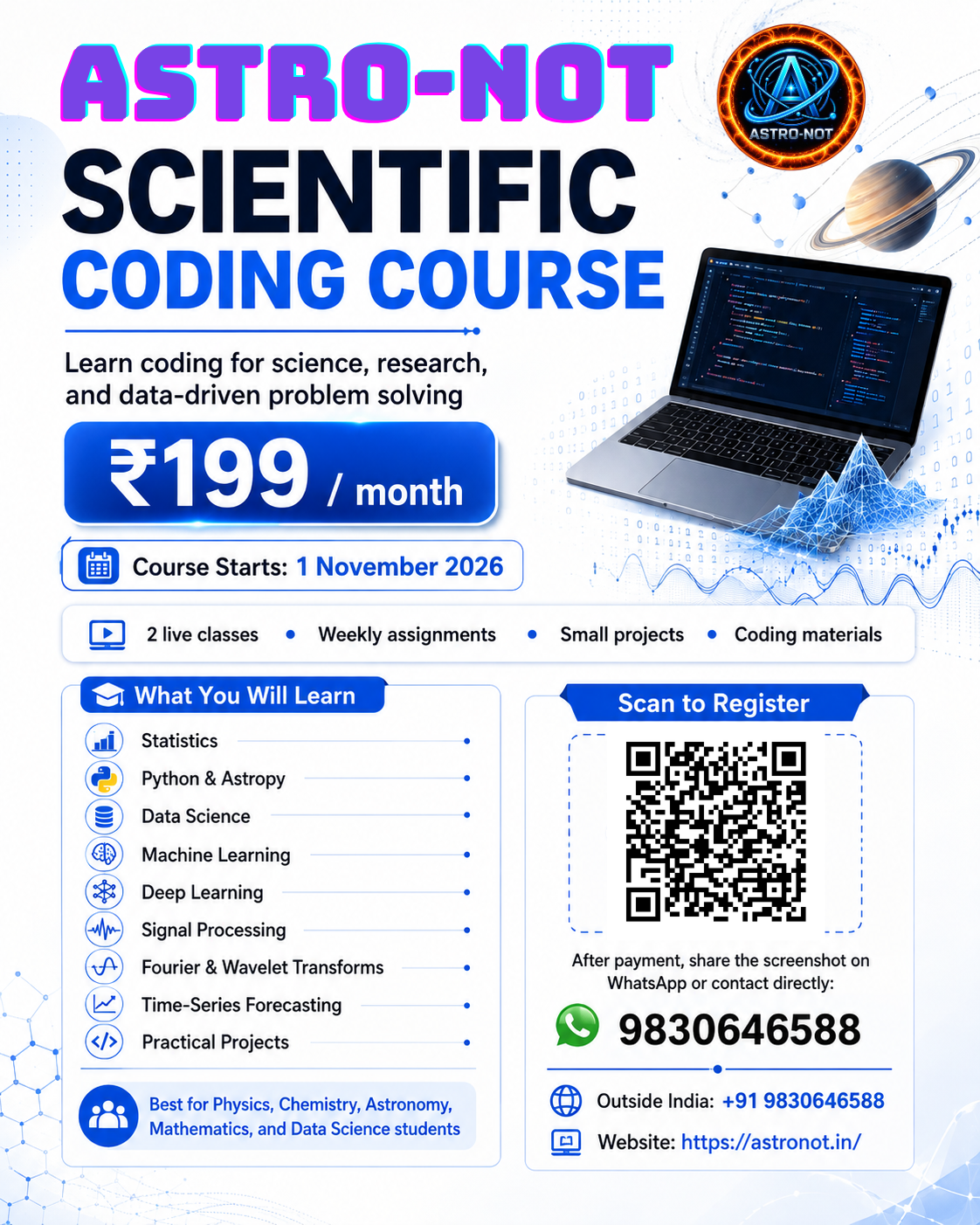
From Basics to Scientific Computing & AI
Build practical coding skills for modern science, research, and data-driven problem solving. The course starts from the fundamentals and gradually moves into scientific computing, data analysis, machine learning, signal processing, and real projects.
- 📅 Starts: 1 November 2026
- 💰 Fee: ₹199/month
- 💻 2 Live Classes Every Month
- 📝 Weekly Assignments
- 🚀 Small Practical Projects
- 📚 Complete Coding Materials
- 📈 Beginner to Advanced
- 🌐 Mode: Online
- 📜 Structured Monthly Learning
What You'll Learn
- Statistics
- Python & Astropy
- Data Science
- Machine Learning
- Deep Learning
- Signal Processing
- Fourier & Wavelet Transforms
- Time Series Forecasting
- Practical Projects
🎓 Best For
Students from Physics, Chemistry, Astronomy, Mathematics, Data Science, and related STEM fields.
How to Register
Scan the QR code on the poster or complete the registration form online. After payment, send your payment screenshot via WhatsApp to:
- 📱 9830646588
- 🌍 Outside India: +91 9830646588
Webinars & Free Projects
Swipe, or use the arrows, to move between what's coming up next.
Open another window
Find your certificate
Type your name below — any way you like, capitals or small letters, with or without a space — and we'll pull it up.
Start typing to see matches.
Open another window
Deep Learning in Astronomy
Free webinar & workshop · 14 October 2026 · 7:30 PM IST · Speaker: Subhash Shankar Pandey
Open another window
Astro-Not Explorer Challenge: 15 free space projects
Celebrate World Space Week with 15 free space projects you can do from home. Each project uses a free online astronomy simulator: you explore orbits, stars, exoplanets and galaxies, solve a mission, and write up what you found. No fees, no installs, open to every student.
The 15 projects
- 01Solar System Models
- 02Coordinates & Seasons
- 03The Rotating Sky
- 04Motions of the Sun
- 05Planetary Orbits
- 06Lunar Phases
- 07Blackbody & UBV Filters
- 08Hydrogen Energy Levels
- 09The HR Diagram
- 10Eclipsing Binary Stars
- 11Variable Star Photometry
- 12Hunting Exoplanets
- 13Atmospheric Retention
- 14Habitable Zones
- 15Cosmic Distance Ladder
How to take part
Read the project brochure
One page per project: what it is and your mission. Pick one project, or as many as you like.
Open the PDFRun the simulators
All 15 simulators are on the Nebraska Astronomy Applet Project (NAAP), free online astronomy labs from the University of Nebraska–Lincoln. Use a laptop or desktop for the best experience.
Go to NAAPWrite your report
One page per project. Do one project, submit one page. Do all 15, submit 15 pages, one short report for each. Include your question, what you did, one figure, your answer and one surprise.
Submit by 31 October 2026
Upload your report (one project or several) through the submission form before the deadline.
Submit your reportParticipation certificate for everyone. Every student who submits a report by 31 October 2026 receives an Astro-Not participation certificate.
“Beyond the sky. Beyond the stars. Into the unknown.”
Open another window
Treat a curious 15-year-old like a scientist, and they behave like one.
ASTRO-NOT exists because astronomy in most Indian classrooms stops at diagrams. We hand students the same data professional astronomers use, and stay with them until they can read it.
- 01Students are researchers, not an audience.
Every program ends with the student holding a result they produced themselves — a rotation curve, a light curve, an HR diagram — not a certificate of attendance. - 02Real data or nothing.
21-cm radio surveys, stellar photometry, transit photometry. If a dataset is good enough for a journal, it is good enough for a school student with a mentor beside them. - 03Cost should never be the filter.
Our workshops run at ₹149. Talent is spread evenly across the country; opportunity is not, and pricing is the easiest part of that to fix. - 04Mentors who are still doing the work.
Our team publishes, observes, and teaches at the same time — so what students learn is how the field actually works today.
A glimpse of the universe we're building
Open another window
What the field just found out
Recent research in astronomy and astrophysics, explained by our team in plain language. Newest first.
Open another window
Our HR Diagram Project Winners & Cash Prize Recipients
Congratulations to the students whose outstanding HR Diagram projects earned them the top three positions and cash prizes.
Open another window
The people behind ASTRO-NOT
Researchers and educators making astronomy accessible to every curious mind.
Open another window
Exoplanet Transit Hunter
A real star is being watched. Every so often something crosses in front of it and the light dips. Measure that dip, do the physics, and tell us what the planet is — exactly how TESS and Kepler scientists do it.
ASTRO-NOT-1b · Photometry Feed
Rp / R★ = √(ΔF/F)Rp = √(ΔF/F) · R★ · 109.2a³ = M★ · P²a = ∛( M★ · P² )Pyr = Pdays ÷ 365.25Your Analysis
Level 1Step 1 — Drag a box across one dip to measure its depth. Step 2 — Click the centre of two consecutive dips to get the period.